


Something fundamental has changed in the silver market.
Not sentiment. Not speculation. Structure.
In this video, Expert Egon von Greyerz explains why silver is no longer trading as a paper instrument, and why what appears to be a price move is, in reality, a transition from paper promises to physical scarcity.
For decades, silver was capped not by supply, but by paper claims.
That constraint is now failing.
The break above $50 is not a technical event.
It marks the point where paper control no longer matches physical reality.

A leveraged market functions only as long as delivery is optional.
When physical demand overwhelms paper supply, repricing happens suddenly, not gradually.

This is not a silver story alone.
It is part of a broader revaluation where financial assets lose ground to real money.

Historically, silver accelerates during monetary stress, while gold anchors value.
This relationship has appeared at every major transition away from paper systems.

Paper systems fail slowly, but reprice suddenly when physical limits are hit.
What looks like volatility is simply the market adjusting to a reality it can no longer ignore.
Silver is being pulled into the physical market, where supply—not sentiment—sets the price.
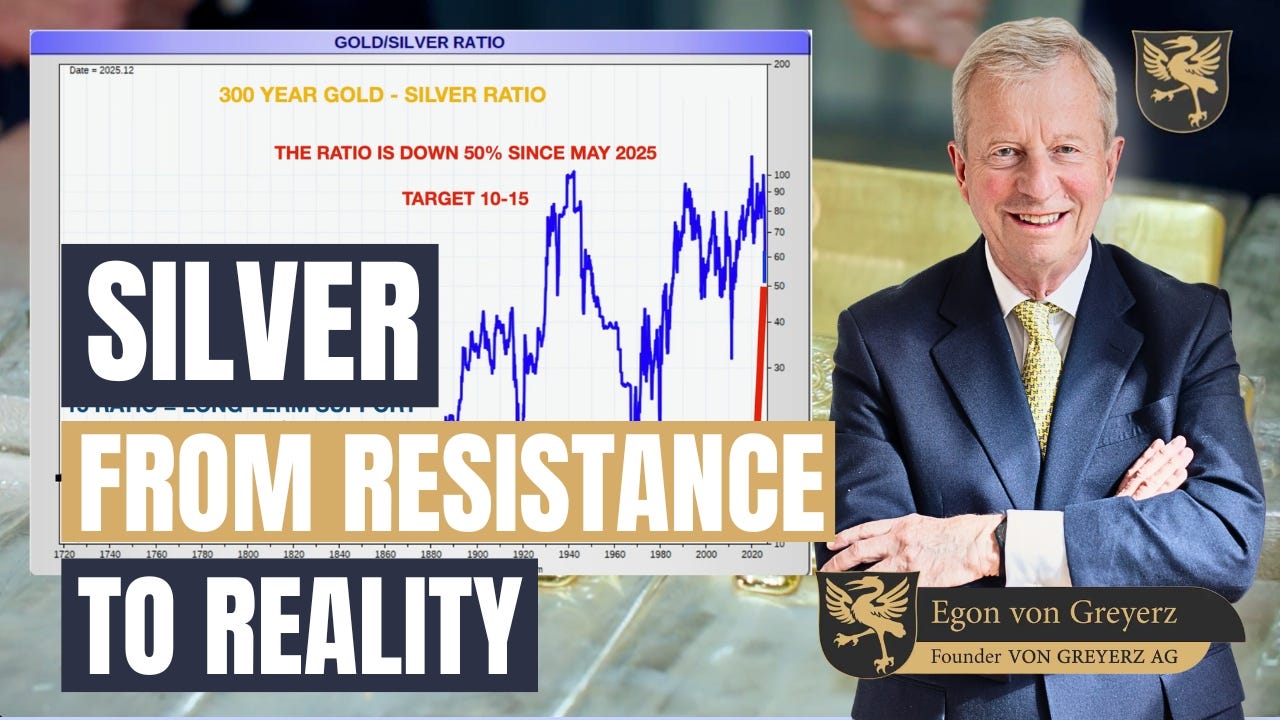
In this presentation, Egon von Greyerz outlines why this move is not about chasing returns, but about understanding where we are in the monetary cycle—and why physical ownership is no longer optional.
KEY INSIGHTS:
00:00 – 01:00 | The $50 Barrier Breaks
Silver failed at $50 in 1980 and 2011 because paper supply could always be created.
This time is different. The move above $50 is not speculative — it is driven by physical shortages.
01:00 – 02:00 | This Is Not a Gradual Market
Silver is not moving step by step.
It is accelerating rapidly through $60, $70, $80, toward $90 and beyond.
Round numbers are psychological — they are not structural barriers.
02:00 – 03:00 | Paper Markets Are Losing Control
Outstanding paper contracts in London and New York vastly exceed available physical silver.
This imbalance marks a structural failure of the paper silver market.
03:00 – 04:00 | From Paper to Physical
Silver is no longer trading as a paper derivative market.
It is reverting to what it has always been: a physical market governed by supply and demand, not leverage and manipulation.
04:00 – 05:00 | Industrial Demand Changes Everything
Physical demand has surged from ~10% of annual production to nearly 50% in one year.
Solar panels, EVs, electronics, and defense systems now compete directly with investors for limited supply.
05:00 – 06:00 | Persistent Deficits
Silver has run production deficits for five consecutive years — and those deficits are growing.
Future shortages are not a possibility; they are already embedded in the system.
06:00 – 07:00 | Physical Ownership Is Non-Negotiable
ETFs and futures do not protect investors in a physical shortage.
True protection requires physical silver held outside the banking system, with direct access.
07:00 – 08:00 | Silver vs. Gold: Speed vs. Stability
Silver is likely to move faster than gold, but with higher volatility.
Gold remains the anchor.
A prudent allocation favors gold as the foundation, with up to 30% in silver.
08:00 – 09:00 | The End of the Paper Era
We are approaching the end of a paper-money system.
Stocks, bonds, and financial promises will lose real value as currencies are debased beyond recognition.
09:00 – End | Preparation, Not Speculation
This is not about trading price targets.
It is about preserving purchasing power and financial survival in a systemic transition.
Gold and silver are not investments of convenience — they are monetary insurance.


