


“Every single money or currency has gone to zero in history.”
The current monetary system is heading toward the same fate.
Since the U.S. ended the dollar’s link to gold in 1971, currencies have already lost about 99% of their value against gold. The remaining decline could happen much faster than the first 99%.
Governments usually describe inflation as rising prices. But that’s the wrong way to explain it.
Inflation begins when governments borrow beyond their means, run persistent deficits, and create more money. As each unit of currency loses purchasing power, it takes more of it to buy the same goods and services.
During the 1970s, the United Kingdom experienced several years of double-digit inflation.
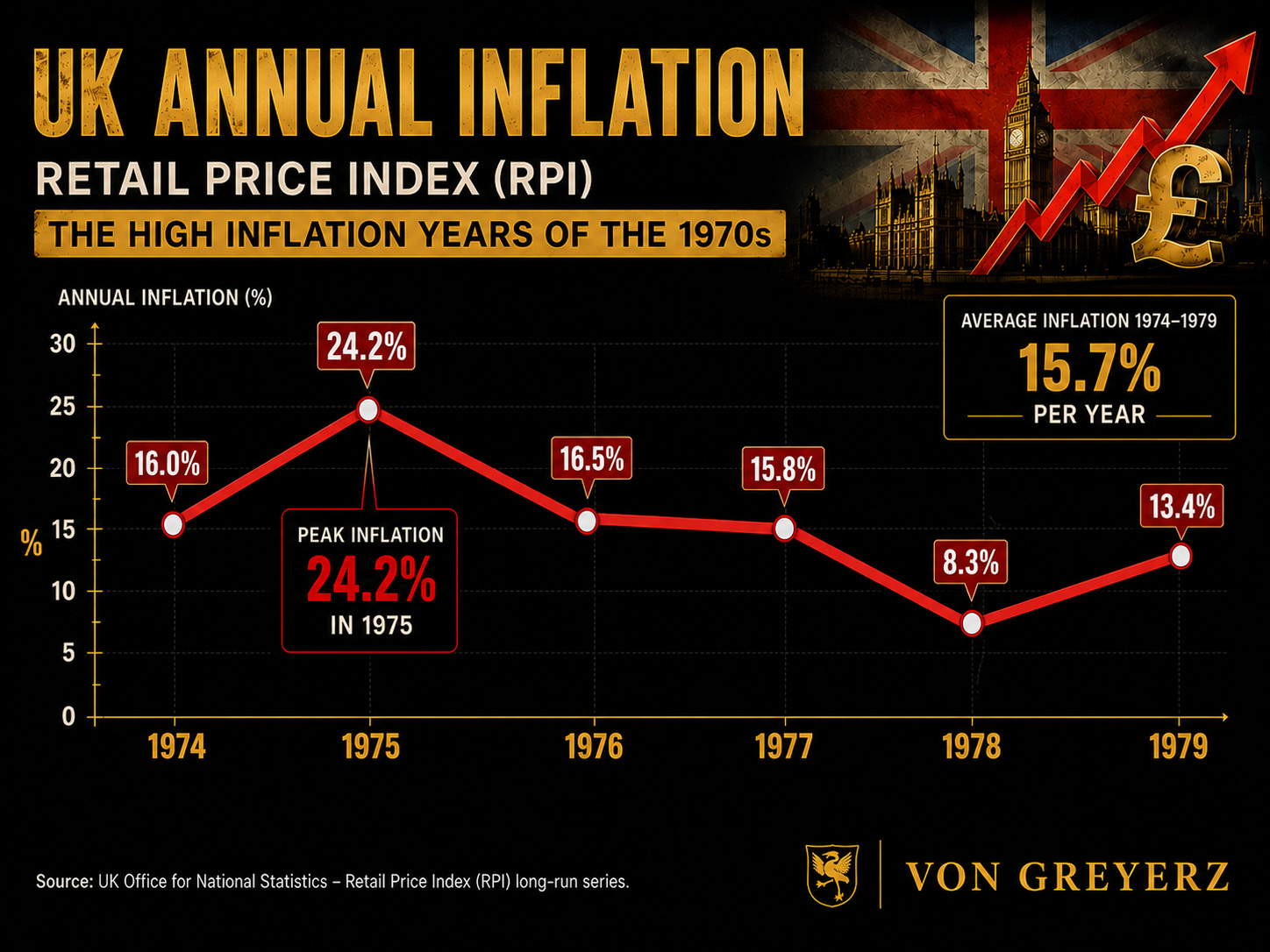
Between 1974 and 1979, inflation averaged 15.7% a year and reached 24.2% in 1975. It was a clear example of how quickly purchasing power can erode once governments lose control of their finances.
The same pattern has appeared repeatedly over the centuries.
One of the earliest examples was the Roman denarius.
Around 180 AD, the coin contained almost 100% silver. By about 280 AD, its silver content had fallen to almost nothing. The denarius was no longer a silver coin but one made largely from base metals.
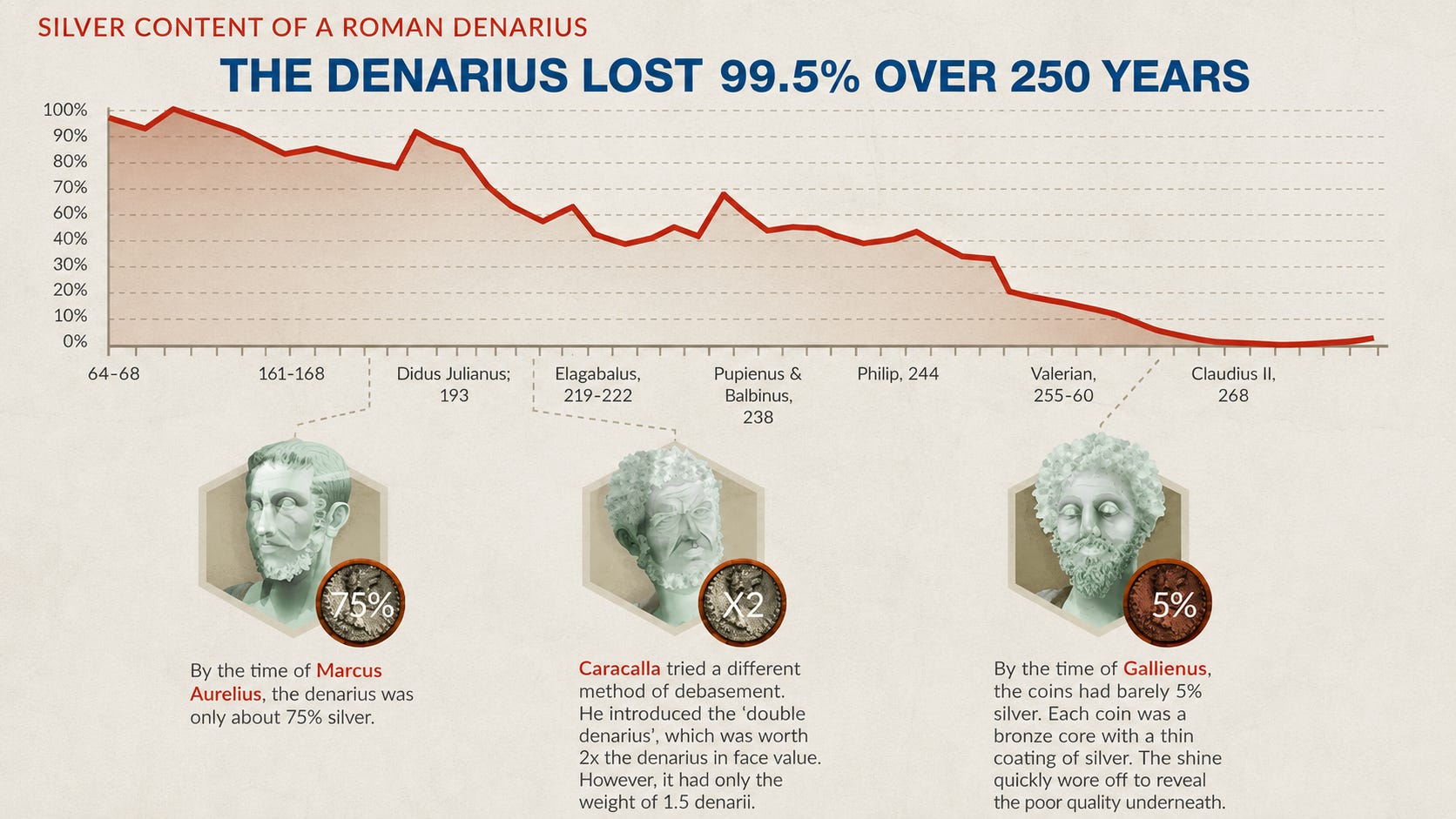
It later happened in France during the early 1700s, in the Weimar Republic in the 1920s, in Zimbabwe, and in Yugoslavia.
The effect becomes clearer when wealth is measured in gold rather than paper currency.
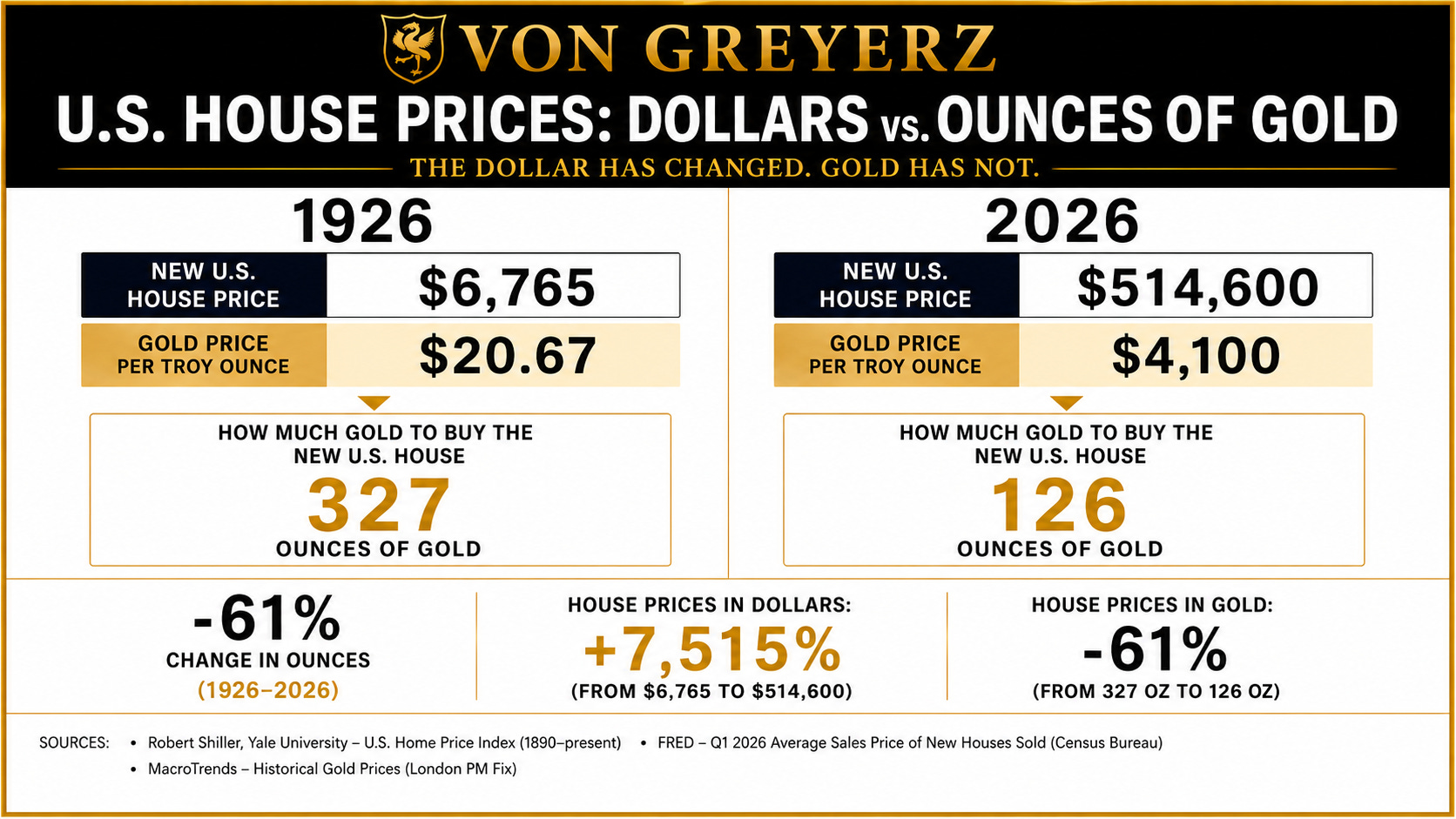
A typical house in the United States cost about $6,700 in 1926, when gold traded at just over $20 an ounce. That worked out to 327 ounces of gold.
A hundred years later, a similar house costs about $514,000. In dollar terms, the price has increased sharply. In gold, however, it has fallen to about 126 ounces.
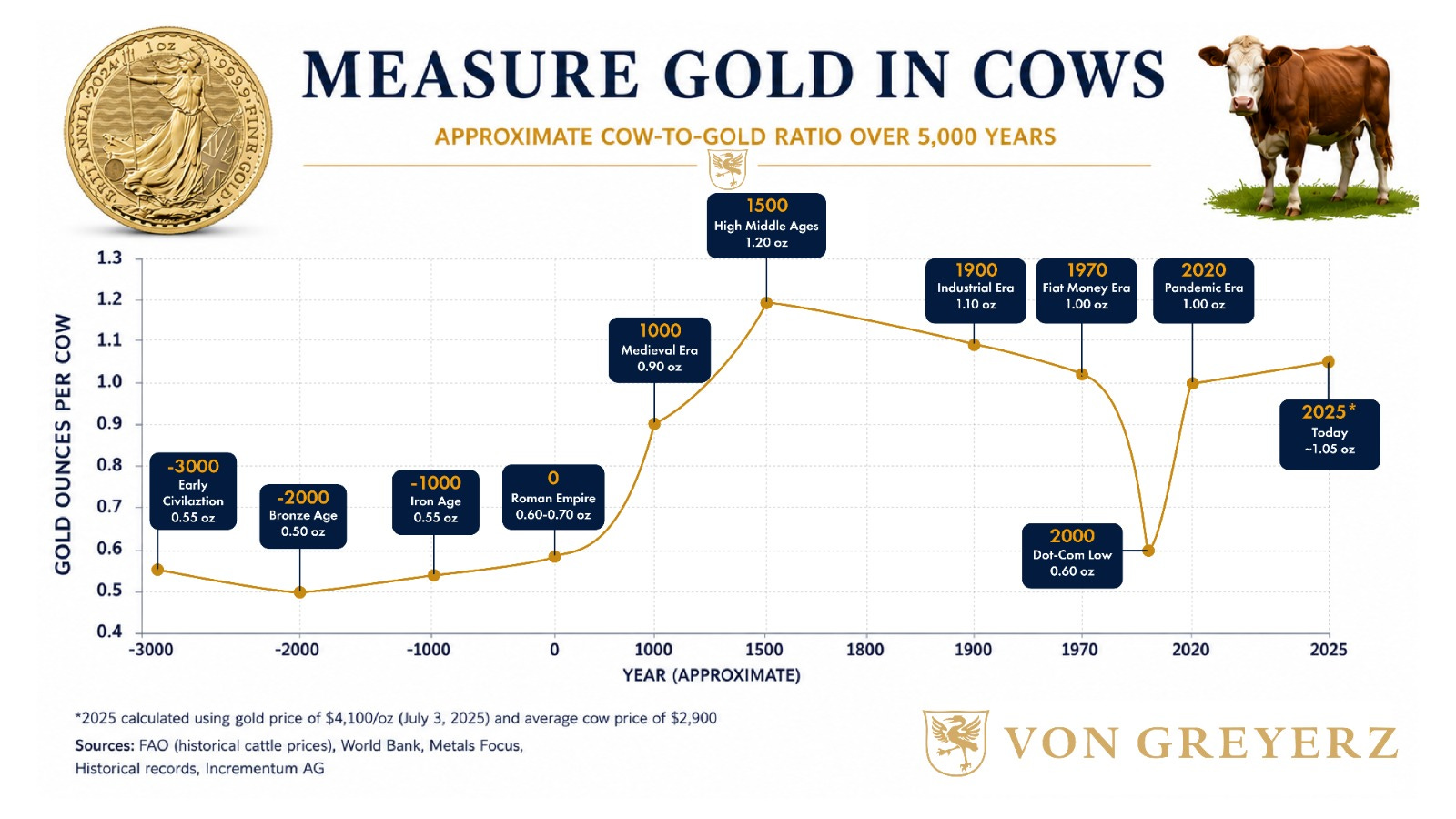
The same comparison can be made with a cow.
Looking back about 5,000 years, the amount of gold needed to buy one has generally remained between half an ounce and one ounce. Unlike paper currencies, cows cannot be manufactured. They take time to raise and represent a tangible asset.
That is why measuring wealth in currencies that lose purchasing power can give a very different picture from measuring it in gold.
“We’re going to have two devastating events hitting us in the next few years. They have already started.”
The first to get hit is the purchasing power of paper currencies.
Next are financial assets. According to Egon, decades of debt expansion and money creation have inflated stocks, bonds, and property.
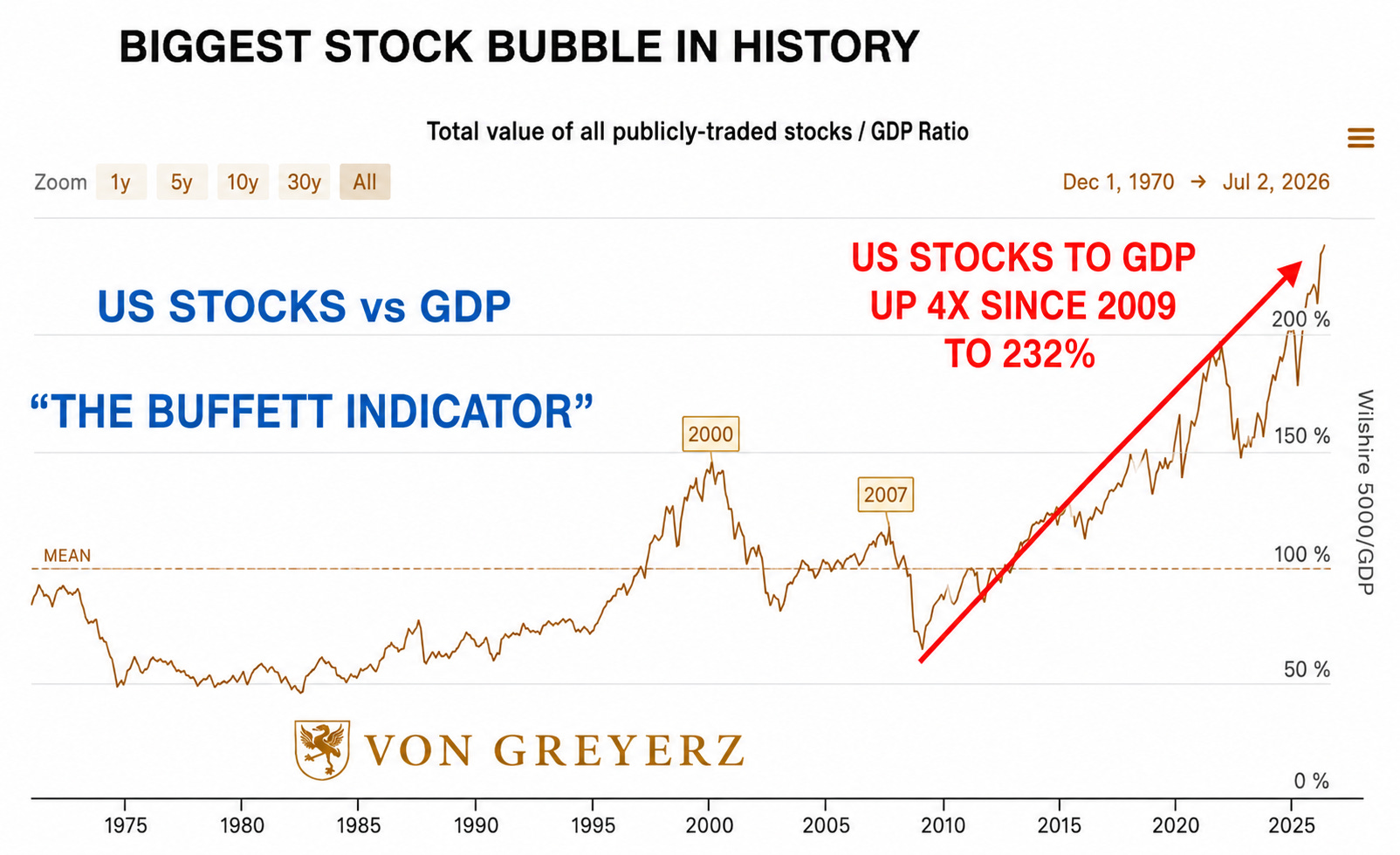
One measure of those valuations is the Buffett Indicator, which compares the value of the stock market with the size of the economy.
Today, the U.S. stock market is valued at more than twice the country’s annual GDP. According to the transcript, that level is unlikely to be sustained for very long.
Another way to view the market is by measuring stocks against gold.
In 1980, the Dow Jones Index and the gold price were both around 850, giving a ratio of one to one. By 2000, that ratio had climbed to about 45 as stocks outperformed gold over the previous two decades.
Since then, gold has outperformed the Dow, bringing the ratio down to around 12 today.
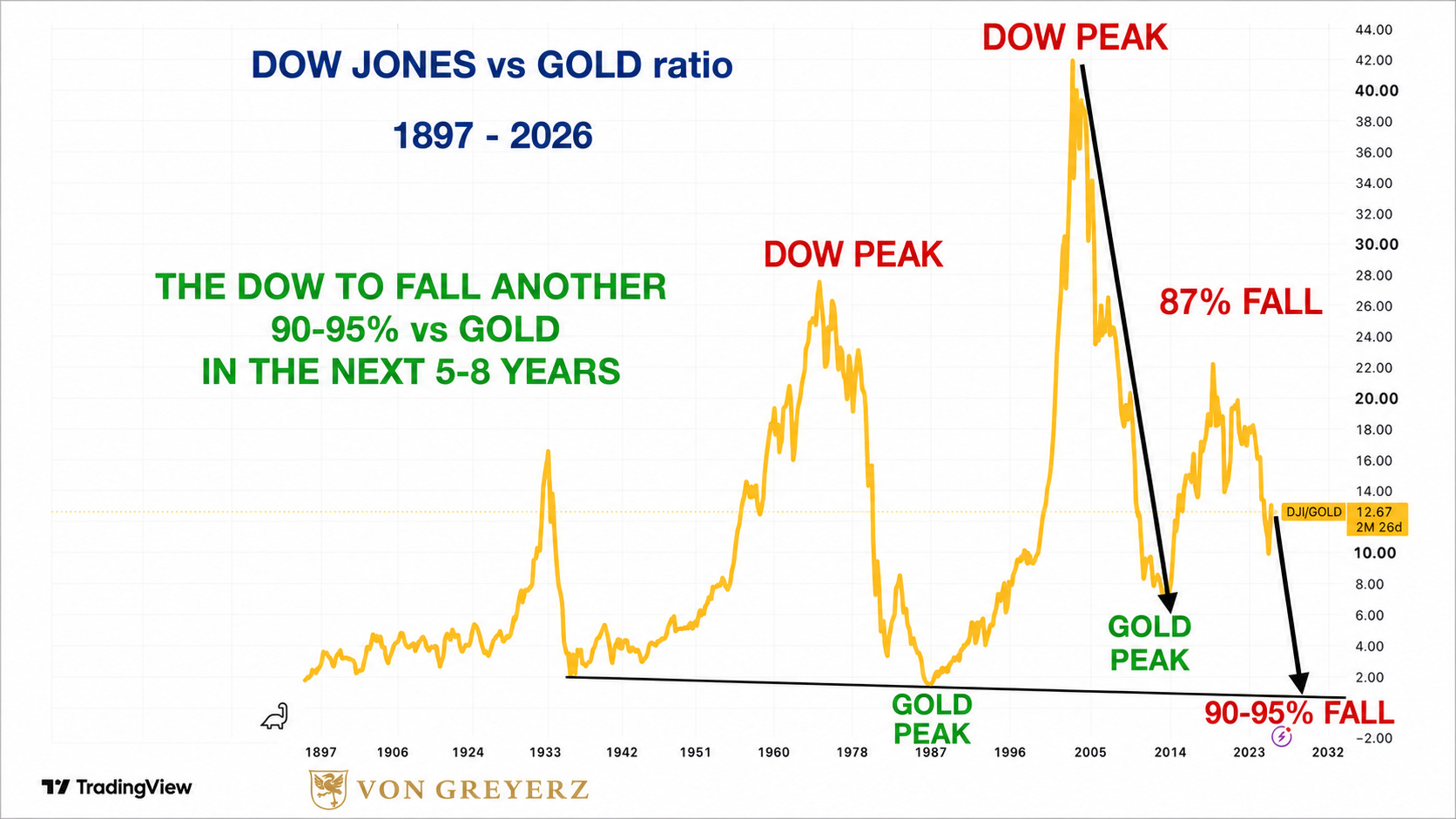
If the ratio returned to one, both the Dow Jones Index and the gold price could stand at 10,000. That would represent a decline of more than 90% in the Dow when measured against gold.
Large losses become much harder to recover from.
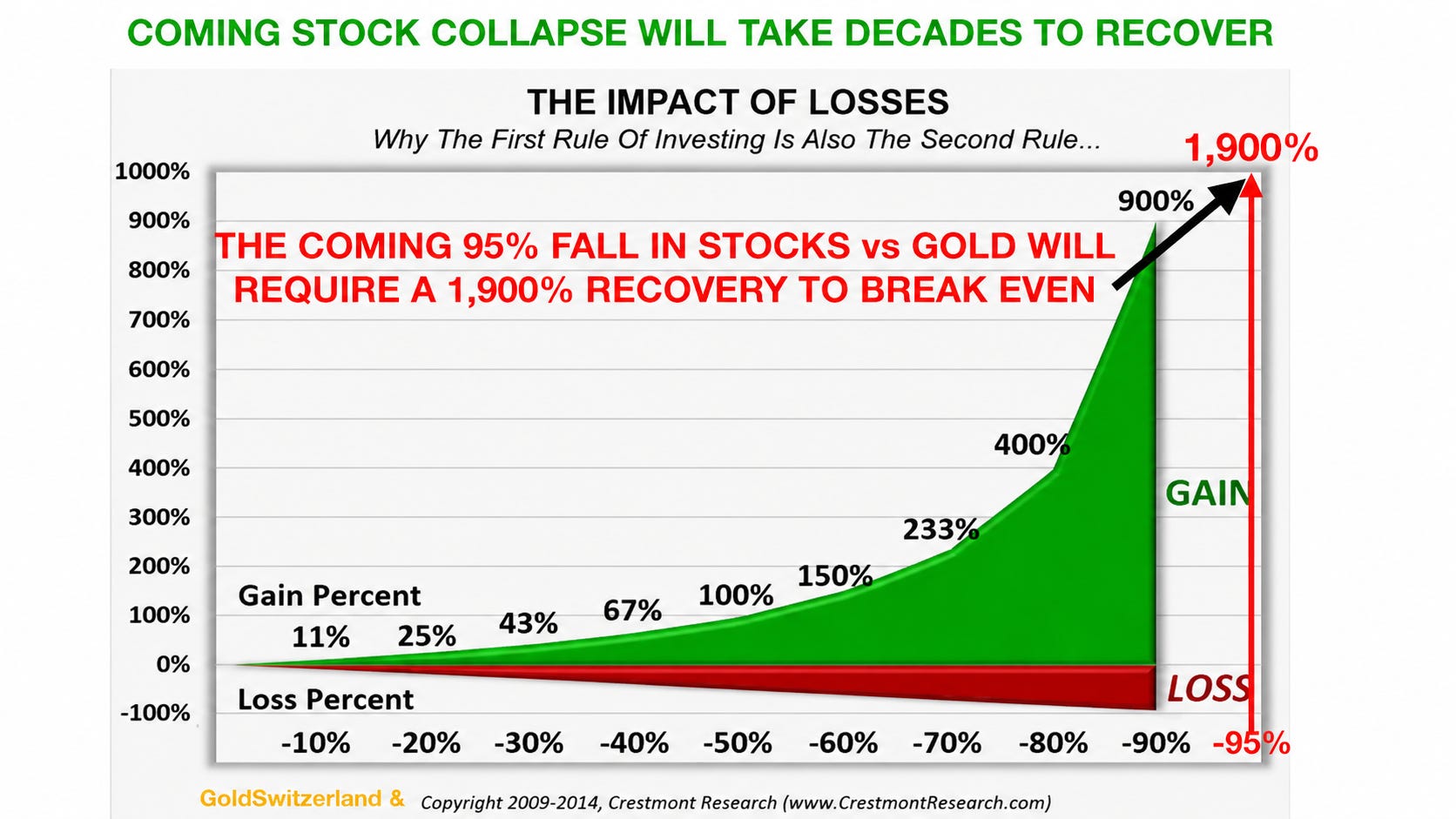
A portfolio that loses 90% of its value requires a 900% gain simply to return to where it started. After the decline between 1929 and 1932, the Dow Jones took twenty-five years to recover its previous peak.
Neither trend guarantees a particular outcome.
But if both continue to unfold, preserving purchasing power may become increasingly important in the years ahead.
Gold and silver have been the exceptions because they cannot be printed or manufactured. For that reason, they remain central to any discussion about long-term wealth preservation.
KEY INSIGHTS
00:00 – 02:25 | Why currencies eventually lose purchasing power
Why every paper currency has eventually failed, the end of the gold standard in 1971, and why inflation begins with the decline in the value of money.
02:26 – 03:21 | The long history of currency debasement
How the Roman denarius, together with examples from France, Weimar Germany, Zimbabwe and Yugoslavia, illustrates the recurring consequences of excessive debt and money creation.
03:22 – 06:28 | Measuring wealth in gold instead of paper currency
Why houses, currencies and even cattle tell a different story when wealth is measured in gold rather than paper money.
06:29 – 08:08 | Two disasters already underway
How continued currency debasement and decades of money creation have led to rising inflation and an asset bubble across stocks, bonds and property.
08:09 – 10:55 | Measuring stocks against gold
How the Buffett Indicator and the Dow-to-Gold Ratio suggest that U.S. equities have become historically expensive relative to gold, and why the ratio could continue falling.
10:56 – 13:15 | Wealth preservation in an era of declining purchasing power
Why recovering from large investment losses can take decades, and why the discussion concludes by focusing on preserving wealth through gold and silver.


