



We’ve entered a new era of economic warfare — not with bullets, but with tariffs.
As of August 1st, a fresh salvo of U.S. tariffs — aimed squarely at the European Union — is shaking global markets, trade alliances, and investor assumptions. Behind the headlines and tweets lies a deeper story: one of unsustainable debt, rising protectionism, and desperate policy measures masquerading as strategy.
Tariffs may sound like policy tools, but in today’s volatile, debt-soaked world, they’re really signals — signals of inflation, recession risk, supply chain fracture, and a broader currency debasement. The question isn’t just what do these tariffs mean? The real question is:
How do you position your capital in a world where trade wars are becoming the new norm, not the exception?
This isn’t just about politics or policy—it’s about your portfolio. And in this environment, those who understand the macro context will survive. Those who act on it can thrive.
KEY INSIGHTS
1. Tariffs Incoming
00:00 – 00:01:11
The U.S. is set to impose new tariffs on the EU starting August 1st, raising questions about their effectiveness, duration, and investment implications amid unpredictable policy shifts.
2. Are Tariffs Good or Bad?
00:01:11 – 00:01:51
Historically, tariffs like Smoot-Hawley have backfired politically and economically. They create inflation initially, but can lead to deflation by suppressing demand.
3. Economic Bullying or Fair Trade?
00:01:51 – 00:02:42
Critics call Trump’s tariffs unfair, but the U.S. points to EU VAT taxes and China’s protectionist history as justification. Global trade has always involved leverage and imbalance.
4. Tariffs vs. GDP
00:02:42 – 00:03:02
Yale and Ivy League studies suggest tariffs reduce GDP by nearly 1%, often negating any revenue gains and creating a drag on economic growth.
5. August Tariff Breakdown
00:03:02 – 00:03:43
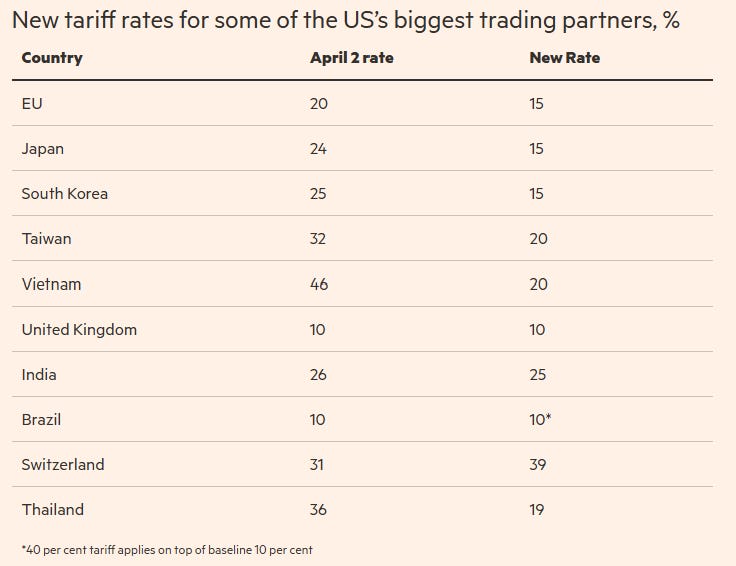
The new tariffs include a flat 15–30% on EU goods, with sector-specific impacts on pharmaceuticals, copper, drones, and steel. Terms are volatile and often shift with politics.
6. Steel, Aluminum, and Quotas
00:03:43 – 00:04:31
Steel and aluminum face 50% tariffs, while the U.S. is also pushing for EU purchase quotas on oil and LNG — though such targets are hard to enforce on private companies.
7. Deal Status: Fluid and Unwritten
00:04:31 – 00:05:20
No formal trade agreements are in place yet. The EU seeks to avoid escalation and may trade tariff concessions for NATO and Ukraine support, but the legal enforceability remains unclear.
8. Reshoring Ambitions, Real Costs
00:05:20 – 00:06:25
The goal is to reshore U.S. manufacturing, but high domestic production costs and import reliance make the timeline for reshoring (especially in pharma) long and expensive.
9. Europe’s Irony: Caught in the Middle
00:06:25 – 00:07:15
European firms producing in the U.S. still rely on EU imports, complicating expansion plans. Many see the tariffs as short-term leverage tactics rather than durable policy.
10. Legal and Political Uncertainty
00:07:15 – 00:07:54
Trump is using emergency powers without Congressional approval, raising legal questions. EU leaders view the chaos as both unpredictable and potentially unconstitutional.
11. Market Risks and Sector Impact
00:07:54 – 00:08:50
Key sectors like steel, oil, pharma, and autos face price shocks. Combined with a concentrated stock market, tariffs risk triggering volatility and possibly a recession.
12. Inflation, Deflation, and Debasement
00:08:50 – 00:09:24
Tariffs drive inflation that eventually depresses demand. The lack of tax offsets means increased deficit spending and long-term currency debasement.
13. Philosophical Perspectives on Trade
00:09:24 – 00:11:03
From Adam Smith to John Nash, competing economic theories question whether self-interest or cooperation yields better outcomes. Current policy favors the former.
14. Fallout and the New Trade Order
00:11:03 – 00:12:15
Global trade cooperation is breaking down. Allies may shift away from U.S. reliance, and long-standing systems like the G7 are under pressure from unilateral actions.
15. Final Outlook: Inflation and Safe Havens
00:12:15 – 00:14:05
With rising debt, unstable trade, and political desperation, all roads lead to inflation. Precious metals like gold and silver offer long-term value in this volatile environment.


