


For most of history, money was not defined by promises, leverage, or paper claims. It was defined by scarcity, trust, and permanence.
When paper currencies expand without limit, their true value can no longer be measured in numbers on a screen. It must be measured against something real.
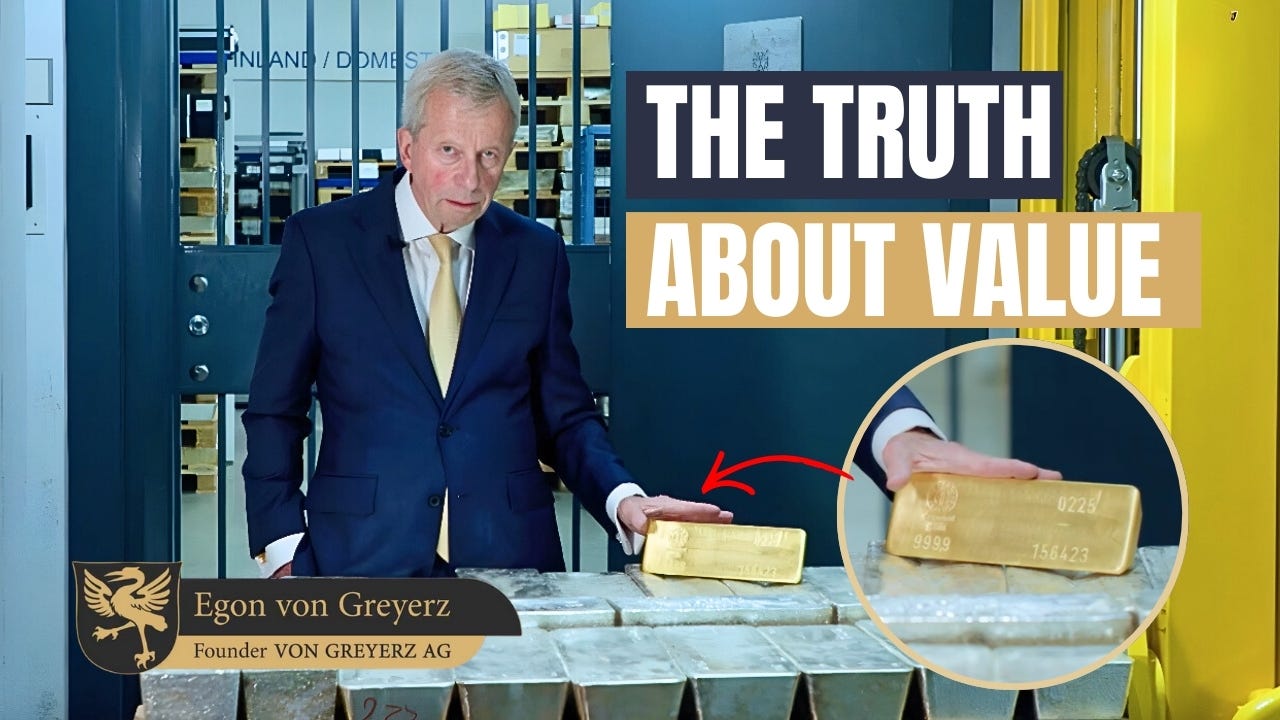
As Egon von Greyerz, founder of VON GREYERZ AG, has consistently explained, gold and silver have always served that role. Not because they fluctuate in price, but because they expose the gradual collapse of paper money.
This comparison between gold and silver is not about weight or volume. It is about monetary density, preservation of purchasing power, and what ultimately survives when confidence in currencies fades.
KEY INSIGHTS
00:00 – 00:30 | Value Is About Density, Not Weight
22,000 ounces of silver sit beside a single 400-ounce gold bar.
The comparison reveals a core monetary truth: gold concentrates value, silver distributes it.
Both are money — but they serve different functions in wealth preservation.
00:30 – 01:10 | Switzerland as a Strategic Monetary Hub
Switzerland refines ~70% of the world’s gold bars.
It also hosts the largest concentration of private gold and silver vaults globally.
Precious metals are not commodities here — they are a strategic national industry.
01:10 – 02:00 | Gold’s Rise Is Currency Collapse in Disguise
A 400-ounce gold bar rose from ~$14,000 in 1971 to over $1.6 million today.
This is not gold “going up” — it is paper currencies losing purchasing power.
Gold simply measures the decline of money.
02:00 – 02:40 | Monetary Density Favors Gold — For Now
Today, 22 silver bars (~$1.1M) are still worth less than one gold bar (~$1.6M).
Gold remains the most efficient store of value per unit of space.
This explains why central banks and large wealth holders favor gold.
02:40 – 03:20 | The Gold–Silver Ratio Is Mispriced
The current gold–silver ratio ~80 reflects distortion, not equilibrium.
Historically, such extremes precede silver outperforming gold.
When the ratio compresses, silver rises faster, not slower.
03:20 – 03:55 | Silver Is Undervalued — and Accessible
Silver remains dramatically undervalued relative to gold.
It allows broader participation in real money ownership.
This is why silver becomes critical late in monetary cycles.
03:55 – 04:30 | The Endgame: Real Money Outside the System
Paper currencies face a structural decline.
Gold and silver rise not by speculation, but by monetary necessity.
Wealth protection now requires physical ownership, stored outside the banking system, in safe jurisdictions.


