


Scott Bessent, the US Treasury Secretary, has argued that 3% economic growth could bring the country’s debt under control.
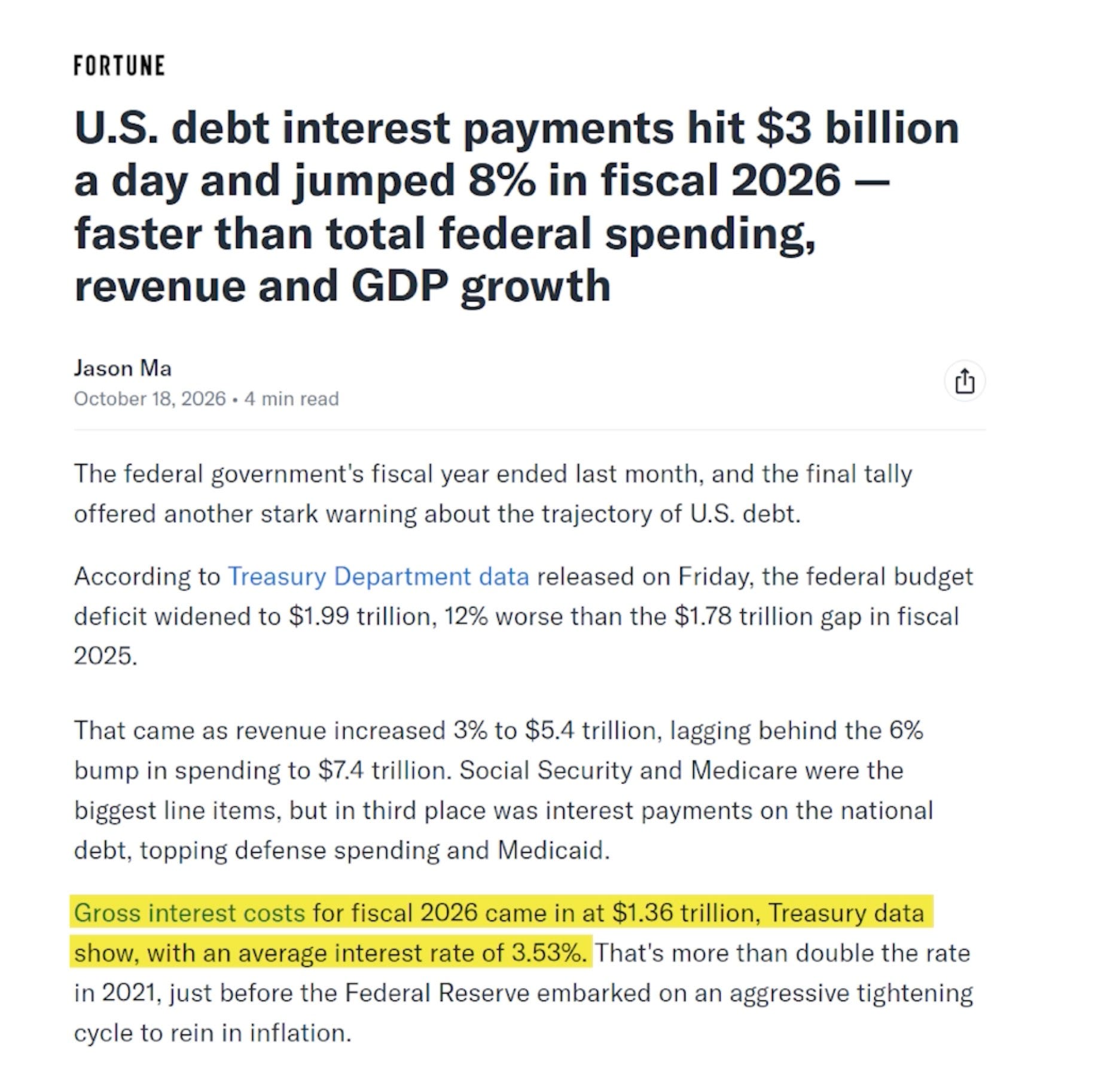
But the gross interest costs for fiscal 2026 reached $1.36 trillion, with an average interest rate of 3.53%.
So, we have two important questions here:
How can the US grow its way out of debt when the cost of servicing that debt is already huge?
What happens if that growth comes from an AI boom that is close to popping?
Printing money does not create wealth
“You print more money, everybody has more money.”
Of course, governments can increase the amount of money in circulation and make the economy appear larger in nominal terms.
But more printed money doesn’t make a country wealthier.
Try to measure that additional money against gold, other currencies, or the rising cost of living, and its apparent “value” quickly comes into question.
The pattern: More government spending than tax revenue → rising budget deficits and government debt → more money printing to finance the shortfall → higher inflation and a weaker currency.
But it cannot go on forever.
The end of the US dollar and US Treasuries
If the US continues down this path, confidence in its currency will eventually disappear. The same applies to US Treasuries.
Nobody will want to lend money to a government that cannot repay its obligations with real money.
Government bonds may promise repayment, but what is that promise worth if the government can only meet it by printing more currency? The money may be repaid in nominal terms, but its purchasing power could be close to zero.
This is how a monetary system comes to an end.
Revaluing assets will not solve the debt problem
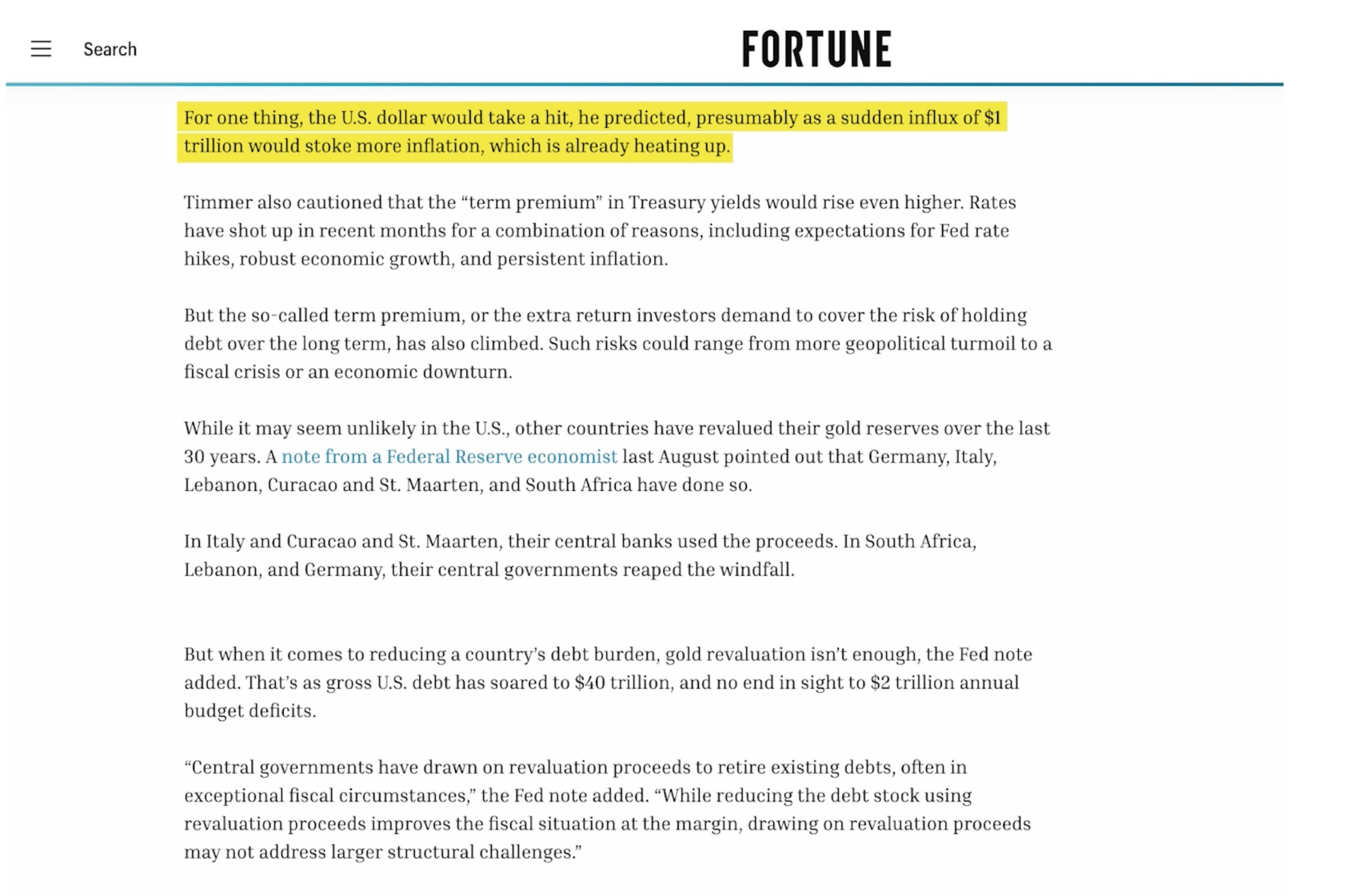
The proposal to revalue US gold reserves could give the government another $1 trillion to spend. But where does this approach end?
“Why don’t we revalue all the government buildings and all the government land and everything the government owns in the US? Revalue that too. Create more money, etc.”
The question highlights the weakness in this approach. Assigning a higher value to an asset does not create additional wealth or make the economy more productive. It changes the value recorded on paper, but does not create anything new.
Real prosperity comes from production. It depends on people working, producing goods and services, and earning money through genuine economic activity.
Financial engineering cannot replace that process.
If governments continue relying on artificial revaluations to create money, the result will be further pressure on the currency, accelerating its decline.
How can ordinary people protect themselves?
We are entering an era that nobody has experienced before. And this is not just an American problem. The monetary system is global.
People should not assume that holding dollars, euros, or pounds will protect their savings. Nor should they wait for governments to tell them when the situation has become serious.
There are some simple steps worth considering:
Avoid unnecessary debt: If you have borrowed against your home, you may eventually find that you cannot afford the interest payments. In the worst case, the bank could take your house.
Buy physical gold and silver: If you have some savings, buy an ounce of gold or silver. If you have more money available, buy a little more.
This is the only way to protect yourself against the failure of the current monetary system.
The end of financial engineering
The next 50 to 100 years will be very different from the period we have just experienced.
It will not be an easy transition. Many people will be scared, unhappy, and poor. Sadly, that is what happens when a monetary system built on debt and money creation finally reaches its limits.
And we should not believe that governments can create money out of nothing and make the problem disappear.
That world is gone.
KEY INSIGHTS
00:00 – 01:16 | Money printing does not create real wealth
More money in circulation may increase nominal figures, but its value falls when measured against gold, other currencies, or inflation.
01:16 – 01:59 | Debt and money printing lead to currency collapse
Rising deficits and government debt drive further money creation, higher inflation, and a loss of confidence in the currency and US Treasuries.
01:59 – 02:57 | Protecting personal wealth in a monetary crisis
Avoiding debt and holding physical gold and silver are presented as ways to protect savings from the decline of paper currencies.
02:57 – 03:32 | The limits of government economic policy
The argument that economic growth can solve the debt problem is challenged, with concerns that continued money printing will only deepen the crisis.
03:32 – 04:44 | Revaluing gold does not create prosperity
Raising the value of gold reserves or other government assets on paper does not create real wealth. Lasting prosperity depends on production, work, and the creation of real assets.


