

Gold. It began the year with galvanic headlines and endless coverage.
Now, midway through that same year, having lost more than 25% from its January high of $5600, many are wondering if peak gold is behind us in the wake of just another broken asset bubble.
Such concerns are understandable, even expected – especially during a shakeout.
Between 1971 and 1980, for example, when gold climbed from $35 to $850, many who loved it in 1980 had been shaken out in 1975 when gold’s paper price plummeted midway through an historical bull run.
As for those defending gold, especially from the desks of precious metal enterprises, they can often seem like apologists at best or salesmen at worst.
This too is understandable. This too is expected.
Gold: So Many Viewpoints
Gold is understood in diverse and extreme ways because a diverse and extreme array of profiles come to it—from day traders and paper exchanges to commercial and central banks to long-term cynics of fiat currencies.
For many, gold is just another commodity allocation. For others, it’s merely an asset or trend to be traded agnostically (long or short) based upon the direction of sentiment and the signals (resistance or support) on their screens.
Gold: A Monetary Viewpoint
For a small (and dare I say, sophisticated) minority, however, gold is much more than just a tradable asset, typical commodity or momentum trade, long or short.
For certain investors, gold is a monetary metal whose paper price fluctuations, though at times frustrating, are of less concern because the historical (and longer-term) debasement of the very currencies which the world otherwise calls “money” is as obvious to them as a cavity to a dentist.
To such investors, gold is understood as real and honest money. As such, it always gets the last and tragic word over dishonest paper money.
But are these understandings correct? How can one understand gold’s future as Wall Street sells you AI while the big banks are stacking gold in a forced fire sale?
The Future of Money Determines the Future of Gold
The seemingly eternal debate, discussion, understanding and hence foreshadowing of where gold is heading (or not heading) depends entirely upon what one thinks of the future of well, money itself.
As in most things — from political debates and athletic contests to wars and even relationships —there are typically two opposing “camps” and narratives in simultaneous play.
And when it comes to gold bulls and bears, these two camps are ultimately divided upon their divergent faiths in the future of paper currencies in general, and the U.S. Dollar in particular.
The Immortal Dollar Camp – Too Big to Fail?
Those whose faith (or story) rests with a USD that can never die will understandably have little interest in a yield-less, anti-fiat “pet rock,” regardless of its recent highs or lows in paper pricing.
Despite the endless tricks behind the politicized Greenback, the Immortal Dollar Camp can see no scenario in which demand for this undeniably and “exorbitantly privileged” currency ever loses its dominance.
Notwithstanding the fall of prior hegemonies of prior currencies and empires (from the Roman, Iberian, Dutch, or British), the Immortal Dollar Camp believes this time (and this dollar) is uniquely different.
To them, the U.S. Dollar, with its “straw-sucking” demand from the Euro Dollar, derivative, petrodollar and global SWIFT exchanges, is simply too big to fail.
Furthermore, with the might and power of the Genuis and Clarity Acts behind the USD, the Immortal Dollar Camp has supreme confidence that the USD will regain its might by rebuilding a dollar-lead payment system on digital rails in which U.S. stablecoins, issued from corporations as diverse as Walmart, Circle Internet, Tether, Apple Pay or JP Morgan, will be loved, bought and absorbed by the world.
Just like the global oil market created a great petrodollar “sponge” for the Greenback, they want you to believe that stablecoins will reignite a similar demand. In this way, the GENIUS Act is, as Trump declared, “the new oil.”
Under this faith, the internet, smartphones, and a wave of stablecoin issuance will effectively replace the Fed’s hitherto role of printing USDs to buy USTs. Now, a global network of e-dollar issuers and e-dollar buyers will save the system.
Hmmm…
The Gold Camp Calling the Dollar’s Bluff?
A small minority of physical gold investors, now joined by a majority of global central bankers, the BIS and the entire BRICS+ coalition, would beg to differ with the Immortal Dollar Camp.
Like China, this camp was calling the dollar’s bluff long before the “debasement trade” made the 2025 headlines.
Since as early as 2014, the world began net-dumping USTs and net-buying physical gold, a process which moved from incremental…
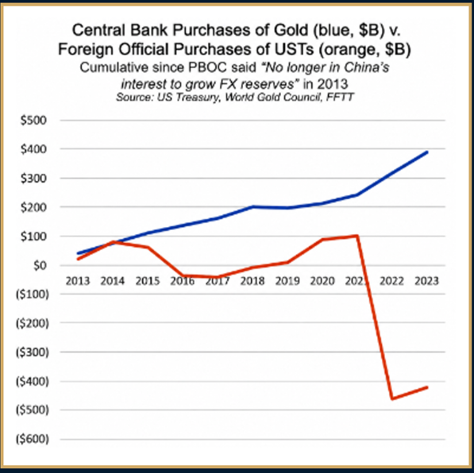
… to exponential after the USA weaponized its dollar in 2022. Since that watershed moment, central bank gold purchasing has increased by 5X:
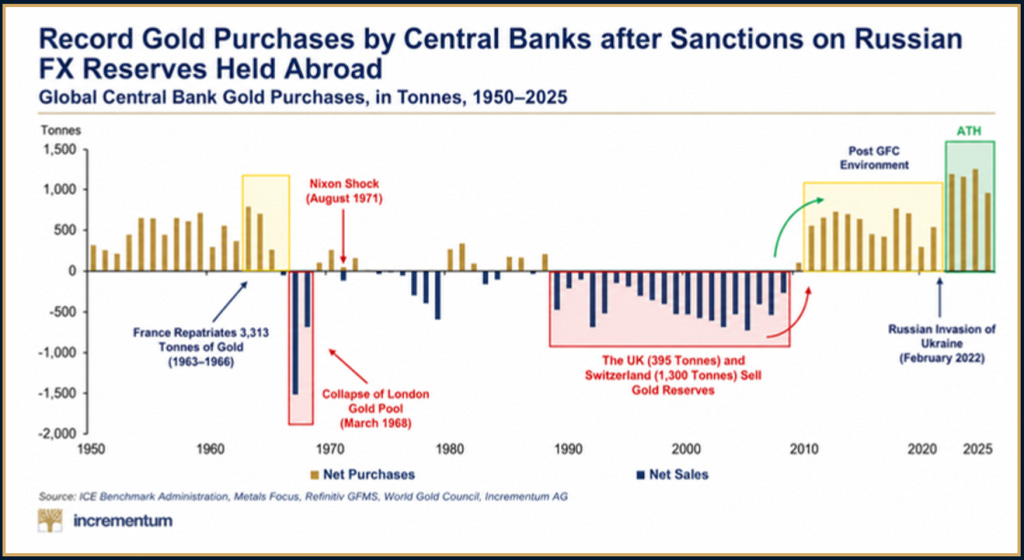
Today, central banks now hold more physical gold than USTs.
Why?
Because they saw the falling direction of paper money in general and the over-indebted USD in particular.
The international gold “camp” was effectively playing physical chess while the dollar struggled with monetary checkers.
The gold stacking which began in 2014 was a subtle starting shot in the race to redefine the idea of “money” in the 21st century.
So, who will be the winner: The digital Greenback or the golden rock?
This, at least to me, is the ultimate question, and as such, one’s genuine and informed view on gold (bull or bear) will hinge upon one’s genuine view of which horse tires first.
Tracking the Race
The S&P
For those backing the Immortal Dollar horse, one way to track its progress has less to do with the current gold price and more to do with doping the thoroughbred.
The Immortal Dollar Camp sees a stock market that never falters due to the Fed (and later, stablecoin) steroids behind its dollar-saving liquidity.
But I, and many others, only see a broken, insider, rigged dollar-based system and market trying to desperately inflate itself for one last lap before exiting the track.
The current S&P 500 is 70% led by 10 names, with 41 companies actually making money and the other 459 tickers flashing flat or negative.
Berkshire Hathaway is sitting on $400B in cash, yet the street is telling you AI, and an admittedly pumped wave of tech IPOs, will save us all.
Time will tell…
Inflation
Despite an openly misreported (and downplayed) official CPI, U.S. inflation is still running at the fastest pace in three years.
But the real measure of inflation is not that bogus scale from the Bureau of Labour Statistics; instead, inflation lies in the embarrassing decline in the dollar’s purchasing power.
Toward this end, the commodities market is telling us just how weak the dollar horse truly is.
The USD price of oil, copper and wheat, for example, has been ripping north for centuries, while the gold price for those same assets has remained steady to even steadily cheaper:
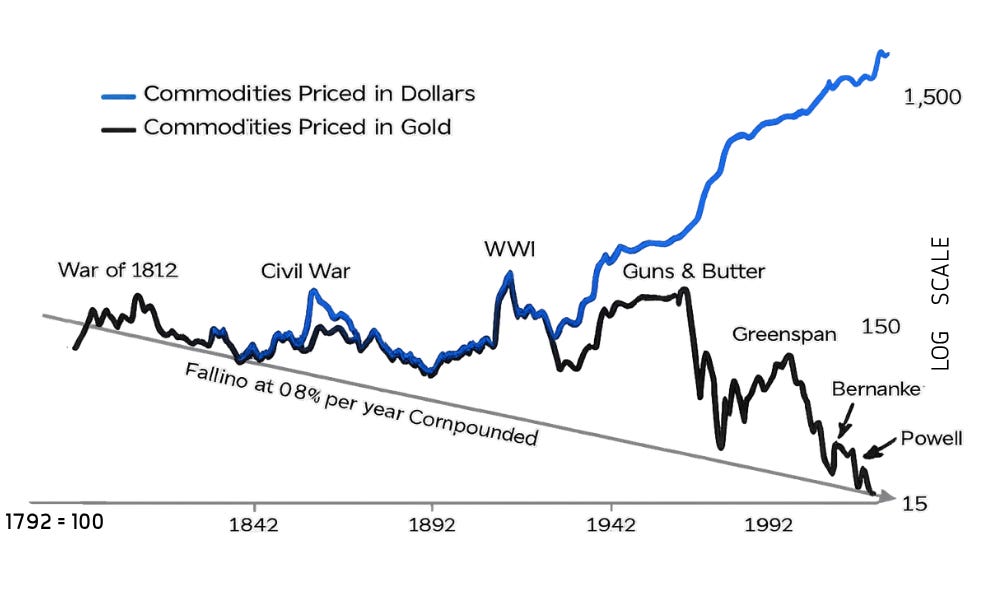
What this chart proves, rather than debates, is that goods aren’t getting more expensive, the dollar is just getting weaker.
The End of the Paper Racket
Meanwhile, the decades-long scam of pretending paper gold was the same as physical gold has been unravelling right before our eyes since 2024.
For centuries, the bankers’ gold hustle was simple: They sold you unallocated gold—meaning no gold at all, just a paper claim to it. They then levered this paper scam to artificially repress the gold price.
In 2021, for example, the London market had about $640B in paper gold claims against $70B in actual gold.
This was a legalized Ponzi Scheme. If gold ever rose dramatically in price enough to create a run on physical rather than paper gold, the big banks, as well as the big exchanges, would get slaughtered.
This explains why an openly nervous BIS, the “mother bank” to all banks, suddenly passed the Basel III rules requiring banks to acquire more allocated/physical gold before the prices skyrocketed.
The BIS was seeing the longer-term direction of the golden hockey puck.
Since then, the London and New York exchanges have been playing all kinds of tricks to force the gold price down to allow the bigger players to acquire precious metals at a discount before the golden horse wins the race.
In other words, even the big banks know that gold will eventually beat the dollar in this historical shift toward real money.
This unprecedented (as well as undeniable) flow to physical metals further explains why the London and NY gold & silver exchanges have run out of the metals. The bigger banks, nations and players want delivery of real gold not unallocated paper.
In short, the physical market has taken over the paper tiger market.
Still Backing the Wrong Horse
The Immortal Dollar camp, however, is non-pulsed by such otherwise flashing signposts. They argue the USD will survive on more growth, more income and more consumer demand.
But here’s the rub: Growth (as everyone from David Hume, Sir Thomas Gresham and Ludwig von Mises reminds) is mathematically impossible at a 125% debt to GDP ratio.
Even Ray Dalio’s simple math concludes that when a nation annually spends $7T with only $5T in revenues, the endgame for its dollar is a foregone conclusion.
China, of course, sees the same thing Dalio sees. In fact, they’ve been years ahead of the curve.
While Western central and commercial banks were still leasing gold and granting tax advantages to holders of paper gold, China (having likely imported 14,000 tons of physical gold since 2015) was stacking and buying the real metal as U.S. bank vaults collected cobwebs for years.
Denial or Genius?
But the Immortal Dollar Camp remains calm despite each of these signposts.
Physical gold, they believe, will never be more trusted than the USD. Unfortunately, the world’s central bankers, the BIS and the BRICS+ coalition think otherwise.
But the Dollar Camp says the AI miracle will save us. In my own opinion, AI will more likely ruin us.
But if you believe AI, along with the GENIUS Act, will create rather than kill more jobs, and hence stimulate more growth, dollar demand, consumer spending and tax receipts, time will have to tell.
We, however, are of the view that an E-dollar doesn’t make a broken, unloved and distrusted dollar any less broken, unloved or distrusted.
Who Wins the Dollar v Gold Race? Ask China?
Whatever we think of China, we can’t just assume they’re stupid. (The greatest military minds have always warned against underestimating the “enemy.”)
China has been patiently stacking gold and devaluing their currency against it with steady determination as part of a much longer-term (and patient) strategy.
China once held over 1.3T in USTs, now they hold about half that.
Though not without their own problems, China sees an incrementally changing global trade and currency system, and have been slowly building for this new direction long before COVID, the Ukraine War or even the latest fiasco in Iran made the headlines:
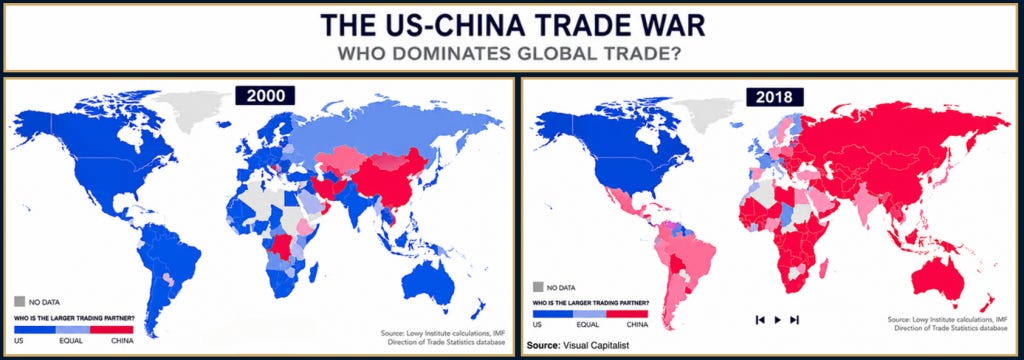
Part of this new direction involves a trading and currency system collateralized and net-settled more in physical gold and less in USTs and USDs.
This new direction, corroborated by disparate yet powerful signals from the BIS in Switzerland to the gold exchange in Shanghai, all suggest that gold is becoming a far more central player in this new direction than a weaponized, debased and over-indebted dollar.
Similar foresight explains the long-term and patient strategy which many “gold bugs,” from Portland, Maine, to Bregenz, Austria, understand all too well.
So, despite recent price falls, will patience and longer-term conviction give gold investors much more reward in the years ahead?
Again: That all depends on the future of real money: Is it going to be led by digital dollars or gold ounces?
History, math and current signals are already providing the answer.

Excellent article. One of the reasons I enjoy reading Matthew Piepenburg's work is that he consistently avoids the temptation of sensationalism while maintaining a remarkably rigorous logical framework. In a world where many commentators compete for attention through increasingly dramatic forecasts, his analysis is usually grounded in first principles rather than headlines.
As someone who shares the Austrian and sound money perspective, I think one aspect of the debate deserves further emphasis. Gold and the dollar are often presented as competitors in a winner-take-all race. Historically, however, the real contest is not between gold and the dollar but between sound money and the political incentives that drive credit expansion.
The Austrian critique was never primarily about predicting the exact date of a currency collapse. It was about recognising that persistent credit creation distorts price signals, encourages malinvestment, and gradually erodes purchasing power. In that sense, gold's significance is not that it will necessarily replace the dollar tomorrow, but that it remains one of the few monetary assets whose value is not dependent on another party's promise to pay.
The question investors should ask is not whether gold will "win," but whether the current monetary system can continue indefinitely without imposing increasing economic costs. History suggests that the destination may be easier to identify than the path. A sound thesis can be correct for many years before markets fully recognise it.
Gold may therefore not need to defeat the dollar to justify its place in a portfolio. Preserving purchasing power through an uncertain and increasingly debt-burdened future may be sufficient.