


According to official membership disclosures published on the Shanghai Gold Exchange website, a growing number of Western financial institutions and refiners are now formally embedded in China’s physical bullion infrastructure.
At the forefront are major European, UK, and U.S. institutions long associated with the Western bullion and derivatives system: UBS, JPMorgan Chase, Deutsche Bank AG (London Branch), Standard Chartered Bank, and Citadel Securities (via its U.S. parent).
These are merely the most visible names in a much longer list (see Appendix).
Their presence on the SGE is not symbolic. It reflects a deliberate shift toward markets where physical ownership is absolutely key, and where metal must exist before it can be traded.
From London’s Paper Hub to Shanghai’s Physical Exchange
For decades, global precious-metals pricing has been anchored in London under the framework of the London Bullion Market Association. This system relies heavily on unallocated metal, leverage, and paper claims that vastly exceed available physical supply.
Shanghai operates on a different premise altogether. On the SGE, precious metals are traded on a physical basis. Settlement means delivery. Metal is weighed, registered, transferred—or withdrawn entirely.
From flatline to surge: China’s bullion build signals the shift from theory to infrastructure.
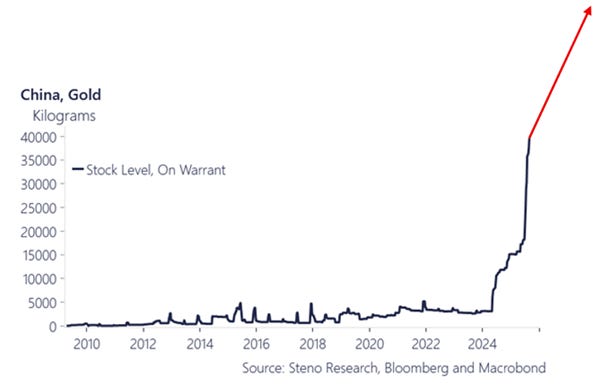
This distinction is not philosophical. It defines the difference between a claim on metal and metal itself.
Why Physical Ownership Now Matters More Than Ever
Paper markets function smoothly until they are tested. When physical demand rises and supply tightens, paper promises reveal their weakness: counterparty risk.
This tension has become increasingly visible in silver, where persistent pricing discrepancies have emerged between Western paper benchmarks and Asian physical markets.
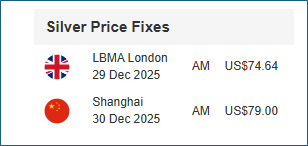
Silver pricing divergence between LBMA London and Shanghai, 30.12.25, Source Bullionstar
When metal becomes scarce, the market that clears in ounces—not contracts—takes control of price discovery.
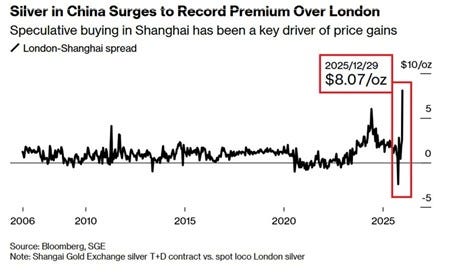
Institutions operating close to physical flows recognized this dynamic long before it reached public discussion.
When Physical Breaks Free from Paper: The ABC Bullion Signal
The paper–physical divide is no longer confined to exchanges and vaults. It is now visible at the point of sale.
A notable example comes from ABC Bullion, one of Australia’s largest precious-metals dealers and a firm closely connected to Asian bullion markets.
Rather than referencing Western paper benchmarks such as COMEX, ABC Bullion has publicly displayed silver pricing aligned with Shanghai levels—at a significant premium to U.S. futures prices. This adjustment reflects replacement cost, not speculation: physical silver cannot be sourced at paper prices when supply is constrained.
Crucially, this shift was not accompanied by a press release or formal announcement. Pricing changed because market reality changed.
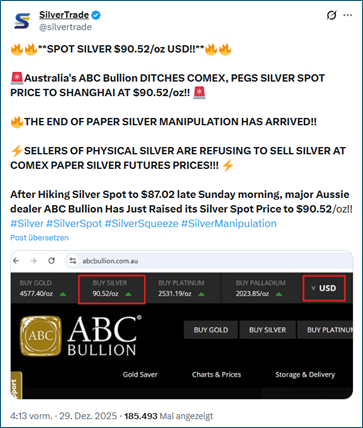
When sellers of physical metal refuse to sell at paper-derived prices, price discovery migrates automatically. In that sense, ABC Bullion is not driving the transition—it is responding to it.
The Smart Money’s Quiet Repositioning
Banks, refiners, and trading firms closest to bullion flows see delivery stress and settlement risk first. Their response has been pragmatic.
By establishing access to the SGE, Western institutions are securing:
Exposure to verifiable physical metal
Participation in delivery-based pricing
Reduced dependence on leveraged paper systems
This is not an exit from London. It is a hedge against its limitations.
Too late to jump on the gold bandwagon?

Beyond the Banking System
True bullion ownership means metal held outright—without reliance on balance sheets, intermediaries, or promises to perform. Physical metal that can be withdrawn, transported, and stored independently is fundamentally different from a ledger entry.
The SGE enforces this distinction structurally. Metal does not circulate endlessly as paper. Once withdrawn, it is removed from the system.
Western institutions aligning with this model are preparing quietly, not posturing publicly.
Conclusion: Watch What Institutions Do, Not What They Say
The shift from LBMA-centric paper markets toward SGE-based physical trade is unfolding without fanfare. It appears in membership lists, vault movements, and pricing behavior—not in official narratives.
Confidence-based systems persist until they don’t. Those closest to the structure adjust first.
When Western giants flock East, it is not a geopolitical statement.
It is a vote for physical ownership over paper claims.
Jan Baltensweiler, jan.baltensweiler@vongreyerz.gold, +41 44 213 62 45
VON GREYERZ AG has earned the trust of HNWIs and investors in over 90 countries, specializing in the secure, fully segregated, unhypothecated, unencumbered, and insured storage of physical gold—entirely outside the banking system.
Appendix: Western Institutions Active on the Shanghai Gold Exchange
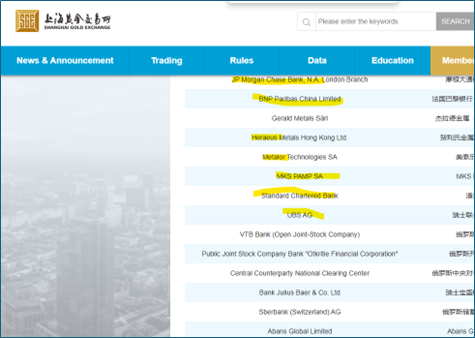
https://en.sge.com.cn/membership_ListofMembers_internationalboard
(Based on official SGE membership disclosures)
United Kingdom
JP Morgan Chase Bank, N.A. London Branch
Standard Chartered Bank
Deutsche Bank AG, London Branch
ICBC Standard Bank Plc
Switzerland
UBS AG
MKS PAMP SA
Metalor Technologies SA
Valcambi SA
Bank Julius Baer & Co. Ltd
Gerald Metals Sàrl
Sberbank (Switzerland) AG
United States (Banks & Trading Firms)
Hudson River Trading Europe Ltd
Jump Trading (US parent)
Jane Street (US parent)
Citadel Securities (US parent)
Tower Research Capital (US parent)
DRW (US parent)
Australia
Australia and New Zealand Banking Group
Gold Corporation (Perth Mint)
European Union
Flowertech C.V. (France / Netherlands)
The evidence is public. The repositioning is real. The implications are structural.
