


It is already happening
On 29 October 2026, hackers drained about $6.3 billion from Binance, the world’s largest crypto exchange. It is the biggest crypto theft in history, four times the previous record, and withdrawals were frozen. The way in was a fake job interview that compromised an engineer’s computer. One laptop.
It is not an isolated case:
$3.4 billion stolen in crypto in 2025 (Chainalysis).
207 hacks in the first half of 2026, the most in any six months on record (TRM Labs).
Over $8 billion stolen in 2026 so far.
Revolut, a bank with 80 million customers, was tricked in September by an email posing as a government agency and handed over the IDs and transaction histories of about 680 customers.
Even the banks admit it
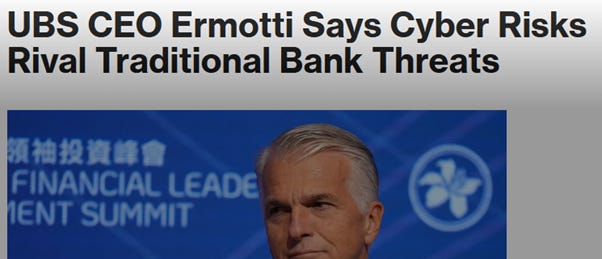
The CEO of UBS, Sergio Ermotti, says cyber attacks now matter as much as credit and market risk, and are growing exponentially.
The man who runs one of the world’s largest banks is telling you that the technology holding your money is a threat on par with a financial crisis.
And it gets worse
Every attack above used today’s tools.
Now add AI, which makes fraud and impersonation cheaper and more convincing every month.
Add quantum computing, which is expected to threaten the encryption that protects financial systems, with no warning date.
Add government digital currencies, which will not be safer than the institutions that cannot stop a fake email. They will be a bigger target.
When your wealth exists only as digital entries, whoever controls the system controls your money: a hacker, a frozen exchange, a bank that suspends withdrawals “temporarily.”
In a breach there is no vault door to bolt.
The money crosses borders in seconds, and by the time anyone notices, it is gone.
The way out
Own something that cannot be hacked because it is not digital: physical assets, held outside the banking system.
Look at how Binance fell, and what changes:
A compromised laptop cannot open a vault.
Centralisation: gold vaults are centralised too, but moving large amounts of gold across borders takes trucks, paperwork and days, not seconds.
Weak safeguards: a real provider knows you personally, and calls you before anything significant moves.
What to look for:
Certified bars with serial numbers, segregated and direct storage in your name, an insured vault outside the banking system, and employees who know you personally.
It is not risk-free.
Gold can be stolen, operators can be dishonest, and fees are real, so choosing the provider matters most.
Nobody is telling you to close your bank account.
The point is that today:
Most of your wealth sits behind passwords
and even a share held physically changes that.
Plan before you need to
Everyone hit by the biggest hacks in history thought it would happen to someone else.
As computing power grows and AI gets smarter, preserving wealth outside the digital system will become unavoidable.
The only question is whether you act while you still have the choice.
Check how much of your wealth exists only digitally.
Decide what share you want held physically outside the digital banking system.
Find a provider with certified bars, segregated storage and insurance, and talk to a trustworthy company and real person.
The time to move is before the headline, not after it.
Plan wisely.
jan.baltensweiler@vongreyerz.gold | +41 44 213 62 45
VON GREYERZ AG has earned the trust of HNWIs and investors in over 90 countries, specializing in the secure, fully segregated gold storage of physical gold—entirely outside the banking system.
Bank accounts frozen, ATMs not working. I go to my coin shop want to sell my gold sovereign. The shop has run out of cash. How does this help me? Barter?